
Rashtriya Gokul Mission: Strengthening India’s Dairy and Rural Economy
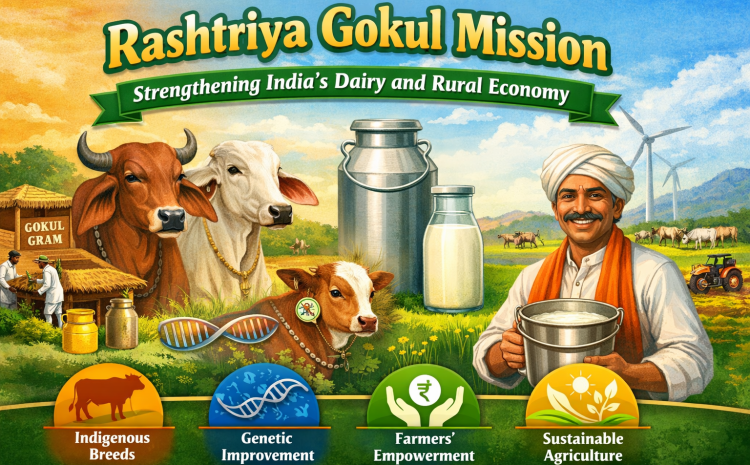
India has long been known as the world’s largest producer of milk, a success largely attributed to the White Revolution. To further strengthen this legacy and promote sustainable dairy development, the Government of India launched the Rashtriya Gokul Mission (RGM) in 2014 under the National Programme for Bovine Breeding and Dairy Development.
The mission focuses on the conservation, development, and promotion of indigenous cattle breeds while improving milk productivity and farmers’ income. It represents a modern, technology-driven approach to traditional cattle rearing.
Objectives of Rashtriya Gokul Mission
The key goals of the mission include:
-
Preserving and improving indigenous cattle breeds
-
Enhancing milk productivity through scientific breeding
-
Promoting A2 milk and organic dairy farming
-
Supporting farmers through financial and technical assistance
-
Encouraging rural employment in the dairy sector
-
Reducing dependency on exotic breeds
The mission recognizes that indigenous breeds like Gir, Sahiwal, Rathi, Tharparkar, and Red Sindhi are not only climate-resilient but also well-suited to India’s agro-climatic conditions.
Key Components of the Mission
-
Gokul Grams (Integrated Cattle Development Centres)
These serve as model centres for cattle breeding, rearing, and productivity enhancement. -
Genomic Selection of Indigenous Breeds
Advanced scientific methods are used to identify high-yielding indigenous cows. -
Sex-Sorted Semen Technology
This increases the probability of female calf births, boosting future milk production. -
Pashu Aadhar (Unique Identification of Cattle)
Every cattle is tagged and registered digitally to track health, breeding, and productivity. -
Conservation of Native Breeds
Special programs are run to protect endangered indigenous breeds.
Benefits to Farmers
Rashtriya Gokul Mission has significantly benefited rural dairy farmers by:
-
Increasing milk yield
-
Reducing cattle mortality
-
Improving cattle health
-
Providing better market access
-
Enhancing rural livelihoods
-
Creating employment in dairy-related activities
Many small and marginal farmers have seen higher incomes due to improved breed quality and better dairy practices.
Role in Sustainable Agriculture
The mission aligns with sustainable farming by promoting:
-
Organic manure usage
-
Reduced chemical dependency
-
Environment-friendly dairy farming
-
Integration of livestock with crop farming
Cow dung and urine are being utilized in organic farming, biogas production, and natural pest control.
Link with Antrastriya Gau Mahotsav
Events like Antrastriya Gau Mahotsav help showcase India’s indigenous cattle heritage, promote awareness among youth, and connect farmers with experts, markets, and technology. These platforms strengthen the vision of the Rashtriya Gokul Mission at a global level.
Conclusion
The Rashtriya Gokul Mission is not just a dairy development program—it is a movement to revive India’s traditional cattle economy, empower farmers, and build a self-reliant rural India. By blending tradition with modern science, it is shaping the future of India’s dairy sector.
🌍 JOIN DHENUDHAN GLOBAL SUMMIT 2026 🌍
Be a part of India’s biggest global gathering on indigenous cattle,
sustainable dairy, and rural empowerment.
Connect with experts, innovators, policymakers, and industry leaders
shaping the future of the dairy and agrarian economy.
